
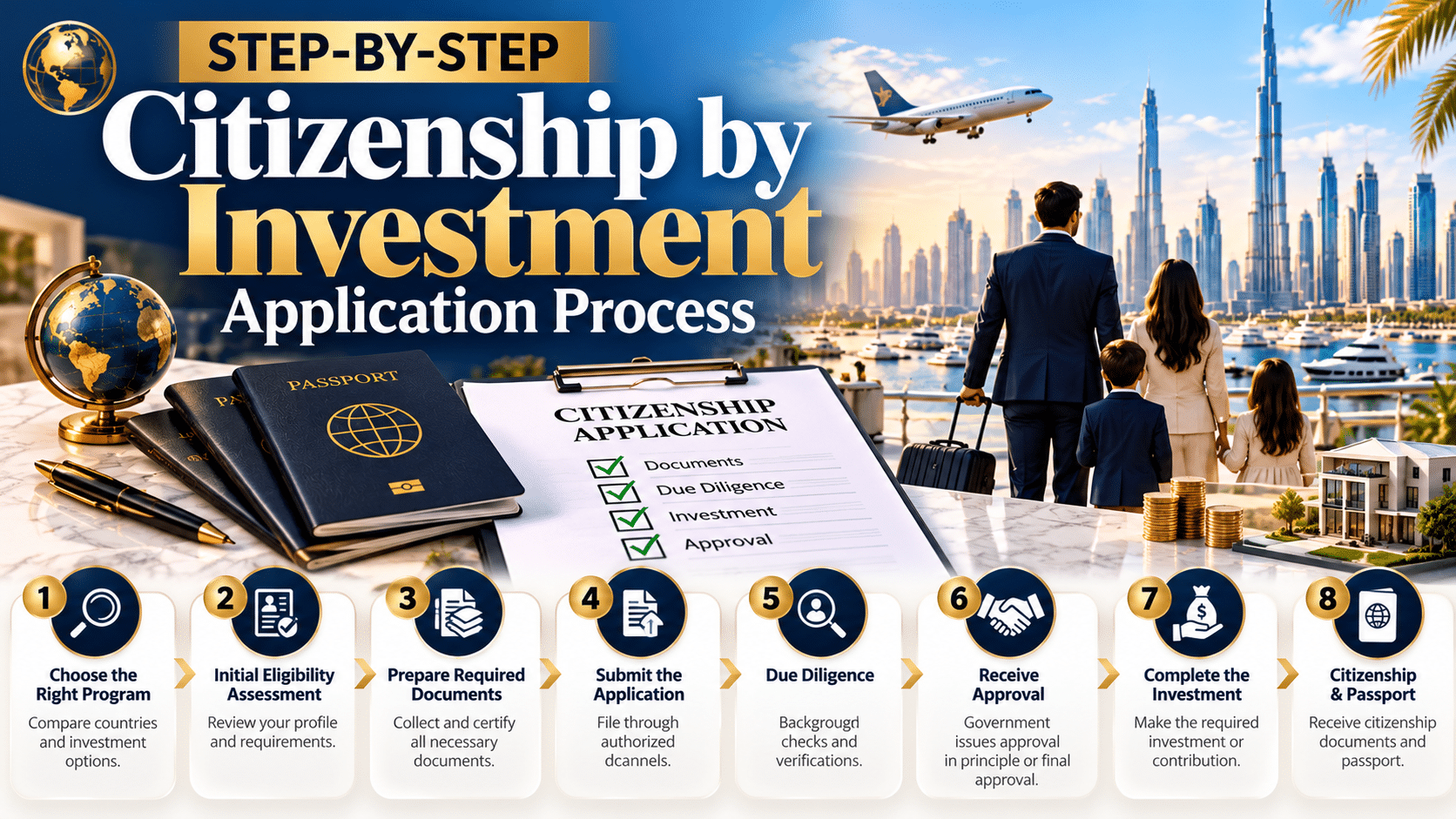
Applying for citizenship by investment is a significant decision that requires careful financial planning, accurate documentation, and an understanding of immigration regulations.
Although application procedures differ between countries, most established programs follow a structured process designed to verify applicant eligibility, investment funds, and legal compliance.
Understanding these stages can help investors prepare effectively and avoid unnecessary delays.
Step 1: Choose a Suitable Citizenship Program
The first step is to evaluate citizenship by investment programs based on your goals.
Some applicants prioritize family inclusion, while others focus on business opportunities, investment structure, or international mobility.
Important considerations include the program’s legal status, investment thresholds, government fees, and eligibility criteria.
Step 2: Complete an Initial Eligibility Assessment
Before submitting an application, applicants should assess whether they meet the relevant country’s requirements.
An initial assessment may cover:
-
Nationality and residency history.
-
Financial background and source of wealth.
-
Criminal record and legal history.
-
Family members included in the application.
-
Ability to meet investment requirements.
This assessment can identify potential issues before significant costs are incurred.
Step 3: Prepare Required Documents
Documentation is a central part of the citizenship application process.
Depending on the program, applicants may need to provide:
-
Valid passports and identification documents.
-
Birth and marriage certificates.
-
Police clearance certificates.
-
Proof of address.
-
Bank statements and financial records.
-
Evidence of source of funds.
-
Medical or health-related documentation where required.
Certain documents may need translation, notarization, legalization, or apostille certification.
Step 4: Submit the Application
In many countries, citizenship by investment applications must be submitted through government-authorized agents.
The application is prepared according to the relevant authority’s requirements and submitted with supporting documents and applicable fees.
Incomplete or inconsistent documentation may result in additional questions or processing delays.
Step 5: Undergo Due Diligence
Due diligence is one of the most important stages.
Government authorities and their appointed screening providers may review an applicant’s identity, financial background, source of funds, and legal history.
Some programs also require mandatory interviews.
Approval is not automatic, even when an applicant has sufficient investment funds.
Step 6: Receive a Government Decision
Following review, the relevant authority may approve, reject, or request further information about an application.
Some programs issue approval in principle before requiring the qualifying investment to be completed.
Applicants should follow the specific sequence prescribed by the government rather than assuming that all programs use the same procedure.
Step 7: Complete the Qualifying Investment
Once authorized under the relevant program rules, applicants complete the required investment or contribution.
Depending on the country, this may involve an approved government fund, qualifying real estate, or another permitted investment category.
All transactions should be documented and completed through legally compliant channels.
Step 8: Citizenship Registration and Passport Issuance
After the applicant satisfies all applicable requirements, the government may issue citizenship documentation.
A passport can then be requested through the relevant issuing authority.
Passport issuance procedures, fees, and timelines depend on the country.
Common Mistakes to Avoid
Applicants should avoid submitting inaccurate financial information, relying on outdated investment requirements, or making payments to unauthorized intermediaries.
It is also important to understand that citizenship approval and visa-free travel are separate matters governed by different laws.
Conclusion
The citizenship by investment process involves more than making a financial contribution. Eligibility screening, documentation, due diligence, and government review are essential parts of a compliant application.
With careful preparation and appropriate professional assistance, investors can navigate the process more confidently.
Need assistance with your citizenship application? Contact Zam Zam Citizenship to learn about program requirements, documentation, and available application pathways.